Knowing how to store olive oil answers one of the most common kitchen questions. Can you use an oil that has passed the date on the label? How long does an open bottle last? Why does an oil smell rancid? The short answer is that olive oil does not go off like milk or meat, but it does lose quality over time. In this guide we explain what the best before date means, how long olive oil keeps unopened and opened, how to tell if it is past its best and how to store it so it keeps all its flavour.
Contents
Does olive oil go off?
Strictly speaking, no. Foods with a use-by date are those that could be a health risk if eaten after that date, such as minced meat, fresh fish or fresh dairy products. Olive oil is not a medium in which bacteria grow, because it contains hardly any water.
What does happen is that oil oxidises slowly and loses its aromas, its flavour and some of its valuable compounds. So when we talk about olive oil shelf life, we are really talking about quality, not safety. An old oil will not make you ill, but it will not taste like a fresh one and it may eventually turn rancid.
The key is to understand the label and to know how to store olive oil properly, from the moment you buy it to the last drop. Once you know the few simple rules below, you will get far more pleasure out of every bottle.

Olive oil shelf life and the best before date
Regulation (EU) 1169/2011, on the provision of food information to consumers, distinguishes between two types of date:
- Use-by date (“use by”). For highly perishable foods. After that date, the food should not be eaten.
- Best before date (“best before…”). Until that date, the producer guarantees that the food keeps all its properties if stored as indicated. After it, the food may still be safe, although its quality declines.
Olive oil carries a best before date. The bottler usually sets it between 18 and 24 months after bottling, depending on the variety, the type of container and their own experience.
Bear in mind that this date is counted from bottling, not from when the oil was made. An oil may have been made a few months before it was bottled, while it rested in protected tanks. So if freshness matters to you, also look for the season or harvest year when it appears on the label.
The key point
Olive oil does not have a use-by date as such: it has a best before date. After that date it is not dangerous, but it has lost aroma and may have turned rancid.
How long olive oil lasts, unopened and opened
Knowing how to store olive oil correctly matters for both unopened and opened bottles. These are the most useful guidelines:
| Situation | Approximate shelf life | Tip |
|---|---|---|
| Unopened bottle or tin, in a cool, dark place | Until the best before date (18–24 months from bottling) | The more recent the harvest, the better. |
| Opened bottle, tightly closed after each use | Between 3 and 6 months to enjoy all its aroma | Choose sizes you can finish in that time. |
| Oil cruet next to the hob or in the sun | A few weeks | Decant only a little and store the rest. |
| Unfiltered oil | A few months from when it was made | Use it soon and with particular care. |
An opened oil does not spoil overnight. Each time you open the bottle, oxygen gets in and oxidation speeds up a little. That is why it is better to buy the size you will use within a few months. A large container is only good value if you finish it while the oil is still at its best.
Varieties also play a part. Those rich in polyphenols and oleic acid, such as Picual or Cornicabra, stand the test of time better. The more delicate ones, such as Arbequina, are best used sooner. We explain this in our guide to olive oil varieties.
How to store olive oil: read the label first
As well as the best before date, the label can give you other clues about how fresh an oil is:
- The batch number. This is compulsory and allows the bottler to identify when and from which tank each bottle came. Some producers include the bottling date in it.
- The season or harvest year. This is not compulsory, but more and more oils show it, for example “2026/2027 Harvest”. It is the most reliable way of knowing when the oil was made.
- Storage conditions. The label usually says to keep the oil in a cool place away from light. Following that advice is what guarantees the best before date.
If you compare two oils in a shop, the one with the later best before date has usually been bottled more recently. But if one of them shows the season, that is the detail that best tells you how long ago it was made. In our shop we show the harvest on the page of every oil.
Does olive oil last longer than other oils?
Compared with other vegetable oils, extra virgin olive oil is particularly resistant. Its fat is mostly oleic acid, a monounsaturated fatty acid that oxidises much more slowly than the polyunsaturated fats in sunflower, corn or linseed oil.
In addition, extra virgin keeps its natural protective compounds, such as polyphenols and vitamin E, which refining largely removes from other oils. So, all else being equal, the shelf life of extra virgin olive oil is longer than that of many seed oils.
This is one more reason why choosing a good extra virgin olive oil pays off in the long run. Flavoured oils, such as garlic, truffle or herb oils, are a different case. Their added ingredients can make them lose aroma sooner. Follow the best before date on the label and use them within a few months of opening.
How to store olive oil: buy without waste
Learning how to store olive oil begins with buying sensibly. These tips will help:
- Work out how much you use. A family that cooks every day can get through several litres a month; someone who mostly uses it raw, much less. Choose the size accordingly.
- Combine sizes. A large container for cooking and a small bottle of a special oil for raw dishes is a very practical combination.
- Buy at the start of the season. New harvest oils arrive between October and December and have their whole shelf life ahead of them.
- Check your cupboard. Use the oldest oil first and keep the most recent for later.
With these guidelines, you will never have to wonder whether your oil has passed its best before date, and you will always have a fresh bottle ready for the dishes that deserve it.
How to store olive oil and slow oxidation
The main process affecting olive oil shelf life is oxidation. Oxygen reacts little by little with the fatty acids, and light and heat speed up that reaction. The result is the formation of compounds that give unpleasant smells and flavours.
At the same time, the oil gradually loses its most valuable compounds:
- Volatile aromas, responsible for the grassy, tomato-plant or apple fruitiness, are the first to disappear.
- Polyphenols, which bring bitterness and pungency and protect the oil from oxidation, decrease over the months.
- Vitamin E and pigments also break down, and the colour may change.
The polyphenols themselves act as a shield: as long as the oil keeps them, it oxidises more slowly. That is why an early harvest oil, very rich in these compounds, usually ages better than one that is poor in them.
Acidity, on the other hand, barely changes in a well-filtered, well-stored oil. If you want to understand that parameter, we explain it in our guide to olive oil acidity.
How to tell if an oil is past its best
When learning how to store olive oil, your senses help you check its condition. Follow these steps:
- Smell it. Pour a little into a small glass, warm it in your hand and smell it. An oil in good condition smells of fresh fruit, grass or fresh nuts.
- Look for a rancid smell. If it reminds you of stale walnuts, wax, paint, modelling clay or old cured-meat fat, the oil has oxidised.
- Taste a little. A rancid oil leaves a greasy feeling and an unpleasant taste in the throat, very different from the clean pepperiness of a fresh oil.
- Look, but do not rely on colour alone. An oil may become paler over time, but colour is not enough to tell whether it is fine.
Cloudiness or sediment at the bottom does not mean the oil is past its best. They are usually natural bits of olive in unfiltered oils, or waxes that settle in the cold. Your nose and palate are always better judges than your eyes.
How to store olive oil away from light, heat and air
Four factors speed up the deterioration of oil. Understanding how to store olive oil means keeping them under control, and that will greatly delay its ageing:
- Light. Especially sunlight and fluorescent light. It triggers oxidation through chlorophyll. A clear bottle next to a window loses quality within weeks.
- Heat. Every extra degree speeds up chemical reactions. The worktop next to the hob, the oven or the dishwasher is the worst place for oil.
- Air. Oxygen is the fuel of oxidation. The more empty space in the container and the more often it is opened, the sooner it ages.
- Metals. Copper and iron catalyse oxidation. Avoid metal oil cruets unless they are stainless steel.
How to store olive oil: choose the right container
Choosing how to store olive oil starts with the container. This comparison will help you choose:
| Container | Protection from light | Comment |
|---|---|---|
| Tin | Total | Ideal for large sizes. Once opened, close it tightly. |
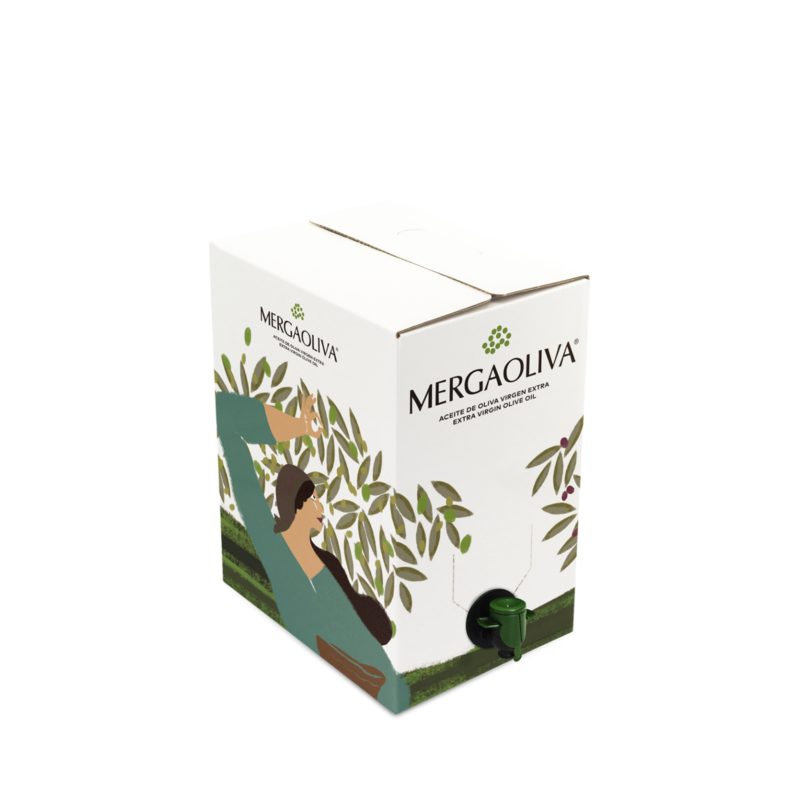
| Bag-in-box | Total | The bag shrinks as it empties and hardly any air gets in. A very good option for everyday use. |
| Dark glass | High | The classic for premium oils. Still keep it in a cupboard. |
| Ceramic or opaque glass | Total | Common in gift boxes. Very good protection. |
| Clear glass or PET | Low | Lets you see the oil, but must always be kept in the dark. |
If you cook a lot, 3 litre tins or the 3 litre bag-in-box are practical and protect the oil from light right to the end.
How to store olive oil at home
If you are learning how to store olive oil, these simple habits help and delay the moment it passes its best:
- Keep the oil in a cool, dark cupboard or pantry, away from sources of heat.
- Keep the temperature as stable as possible. Sudden changes also harm it.
- Close the container tightly after each use. If you use a cruet, make sure it has a lid.
- Use a small cruet made of dark glass or stainless steel and top it up little by little from the large container.
- Wash and dry the cruet thoroughly before refilling it. Do not mix new oil with the remains of old oil.
- Do not keep the oil near products with strong smells: it absorbs aromas easily. Cleaning products, spices and onions are best kept on a different shelf.
With these guidelines, a good extra virgin olive oil keeps its quality for many months. And if you buy it at the start of the season, like new harvest oil, you will have fresh oil all year round.
Cloudy or solid oil in the cold
If you keep oil somewhere cold, in the fridge or in a garage in winter, it may turn cloudy or form whitish lumps. This is not a defect or a sign that the oil is past its best: some of its components, such as waxes and certain fatty acids, solidify at low temperatures.
Just leave it at room temperature for a few hours and it will look normal again. Do not heat it on the hob or in the microwave. And, in general, there is no need to keep oil in the fridge: a cool pantry is enough.
In fact, moderate cold is good for oil: it slows down oxidation. What you should avoid is constant temperature changes, for example taking the bottle in and out of the fridge every day, because this encourages moisture to condense inside the container. If you live somewhere very hot, an inside pantry or a cupboard away from the kitchen is the best option in summer.
Frying oil: how many times to reuse it
Extra virgin olive oil is very heat-stable and can be reused for frying a few times, as long as it is done properly:
- Do not overheat it. If it smokes, it has gone past the right temperature and is breaking down.
- After frying, let it cool and strain it through a fine sieve or kitchen paper to remove food particles.
- Store it in a clean, closed container, away from light and separate from fresh oil.
- Keep used oil for similar foods: do not fry chips in oil that has been used for fish.
- Throw it away when it becomes very dark, foams, smells bad or turns thick.
As a rough guide, a well-cared-for olive oil can be reused a few times. Beyond that, the quality of the fried food suffers: it absorbs more oil, browns unevenly and picks up stale flavours.
What to do with old oil
If your oil has passed its best before date but smells and tastes fine, you can use it for cooking without any problem. If it is rancid, it is best not to use it: it is not dangerous in small amounts, but it passes its unpleasant taste on to your food.
Never pour it down the sink or the toilet, because it pollutes water and blocks pipes. Keep it in a closed bottle and take it to a recycling centre or to your local used cooking oil collection point.
Fresh new harvest oil, in the size you need. Bottles, tins and bag-in-box of extra virgin olive oil from Spanish mills, with fast dispatch within 24/48 h from Spain.
Frequently asked questions: how to store olive oil and its shelf life
Can you use olive oil after the best before date?
Yes, if it has been stored well and does not smell or taste rancid. It will have lost some of its aroma, but it is not a health risk.
How long does an opened bottle of olive oil last?
Ideally, use it within 3 to 6 months to enjoy all its aroma, as long as you close it tightly and keep it in a cool, dark place.
How to store olive oil: is the fridge necessary?
No, but it turns cloudy or solidifies. Once back at room temperature it looks normal again. There is no need to keep it cold.
How do I know if my oil is rancid?
By its smell and taste: it is reminiscent of stale walnuts, wax or paint, and leaves a greasy feeling in the mouth.
Which olive oil keeps longest?
Extra virgin olive oils rich in polyphenols, such as Picual, Cornicabra and early harvest oils, packed in tins, dark glass or bag-in-box.
Now you know that olive oil shelf life is above all a question of quality and good storage. Buy it fresh, learn how to store olive oil properly and enjoy it at its best. A cool, dark cupboard, a well-closed container and a sensible size are all it takes to keep every bottle tasting the way the mill intended.